Case study 05
Subsea Pipeline Fracture Assessment
An educational fracture-mechanics study investigating how pressure and assumed crack depth affect a simplified toughness screening calculation for a subsea pipeline.
- Discipline
- FRACTURE MECHANICS / PYTHON / SUBSEA
- Course
- TMM4142 — Finite Element Methods in Structural Analysis
- Project type
- academic
- Period
- Autumn 2025 · analytical extension 2026
- Evidence
- Analytical model + unit tests
- My role
- Individual analytical modelling and implementation
01 / Engineering challenge
The system behind the project
A detected crack in a pressurised subsea pipeline requires more than a comparison between nominal stress and yield strength. The project examines fracture-driving force while accounting for internal pressure, hydrostatic external pressure, pipe geometry and an assumed longitudinal surface-crack depth. The current model is deliberately presented as educational screening rather than a fitness-for-service assessment.
02 / My responsibility
What I personally worked on
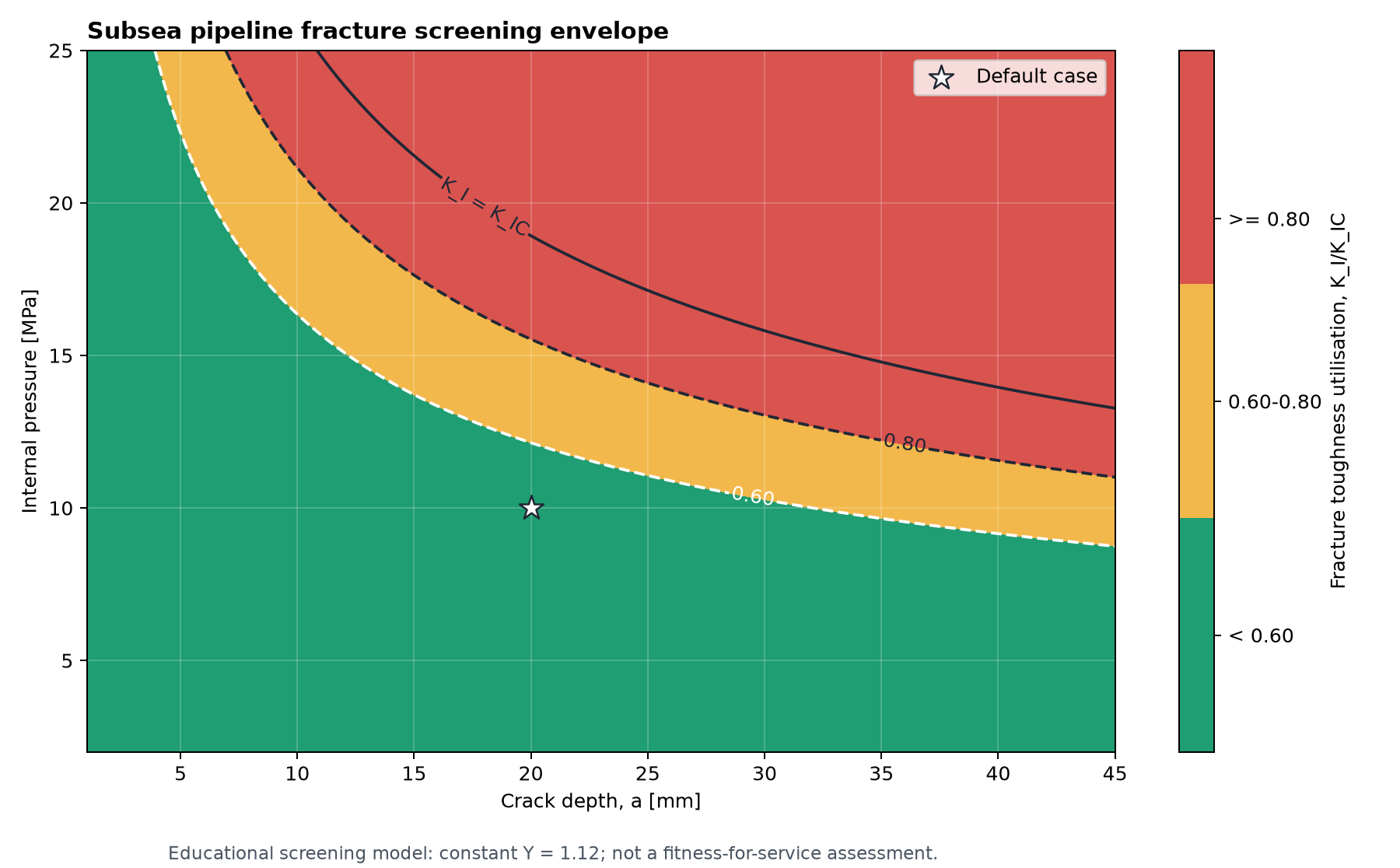
Extended my original TMM4142 assignment into a reproducible Python workflow. I implemented the pressure, hoop-stress, stress-intensity and plastic-zone calculations, added automated engineering checks and tests, and generated a pressure-versus-crack-depth screening envelope.
Engineering focus
- — Analytical fracture mechanics
- — Stress-intensity screening
- — Pressure and crack-depth sensitivity
- — Finite element modelling in Abaqus
Tools and methods
03 / Design and implementation
From concept to working system
- 01
Calculate hydrostatic external pressure, net pressure and thin-wall hoop stress at the pipe mean radius.
- 02
Estimate Mode I stress intensity using the original simplified geometry factor and compare it with the supplied fracture toughness as a screening indicator.
- 03
Evaluate Irwin plastic-zone estimates together with thin-wall, elastic-stress, plane-strain-size and small-scale-yielding checks.
- 04
Sweep internal pressure and crack depth to generate a reproducible toughness-utilisation envelope and selected pressure boundaries.
- 05
Verify the implementation with unit tests reproducing the hand calculations, scaling behaviour, input validation and pressure-boundary calculations.
04 / Testing and outcome
What the work demonstrated
For the default educational case, the model gives 1.962 MPa external pressure, 8.038 MPa net pressure, 84.399 MPa hoop stress and a simplified K_I of 23.694 MPa√m, corresponding to K_I/K_IC = 0.474. The thin-wall, elastic-stress and small-scale-yielding screening checks pass, while the plane-strain-size check fails because the 20 mm crack dimension is below the calculated minimum of approximately 30.86 mm. The results are therefore presented as a reproducible sensitivity study, not as a safe-operating or fitness-for-service conclusion.
05 / Next iteration
How I would develop it further
- 1Rebuild the Abaqus model with separated crack faces, a defined crack front and an appropriate local crack-tip mesh
- 2Evaluate multiple contour integrals and document contour stability together with a three-level mesh-convergence study
- 3Compare the converged numerical result with a cited analytical surface-crack solution rather than relying only on the constant geometry factor
- 4Add clean Abaqus geometry, mesh, stress and crack-front result exports to the repository and case study