Case study 06
Machine Learning for Engineering Systems
A three-part academic project applying supervised learning, unsupervised anomaly detection and reinforcement learning to engineering problems: concrete-strength prediction, industrial pump monitoring and simulated building-climate control.
- Discipline
- MACHINE LEARNING / ENGINEERING DATA / INTELLIGENT CONTROL
- Course
- TMM4128 — Machine Learning for Engineers
- Project type
- academic
- Period
- Spring 2026
- Evidence
- Control code
- Team
- 3 engineering students
- My role
- Primary technical contributor
01 / Engineering challenge
The system behind the project
The coursework examined how different learning paradigms fit different engineering decisions. Labelled material-test data supported regression, unlabelled multivariate sensor histories supported anomaly detection, and a simulated sequential control problem supported reinforcement learning. The emphasis was on selecting methods, evaluating evidence and recognising where a model was not yet suitable for deployment.
02 / My responsibility
What I personally worked on
I was the primary technical contributor across the three assignments and carried out most of the data preparation, Python implementation, model training, evaluation, visualisation and written synthesis. The work was submitted by a three-person group, with the other members contributing discussion and feedback, so the project remains credited as collaborative work rather than as an individual submission.
Engineering focus
- — Regression for material-property prediction
- — Unsupervised anomaly detection for pump sensors
- — Deep reinforcement learning for simulated control
- — Model evaluation and engineering interpretation
Tools and methods
03 / Design and implementation
From concept to working system
- 01
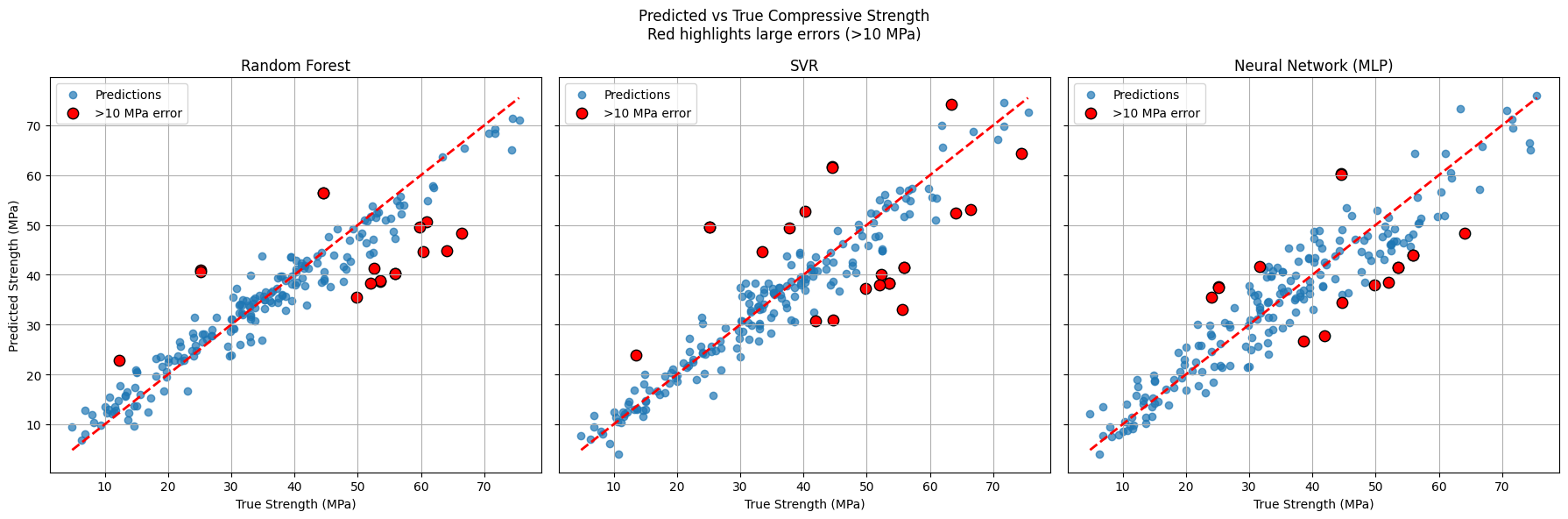
Train and compare regression baselines, Random Forest, SVR and neural-network models on 1,030 concrete mixes with eight input variables, using MAE, RMSE and R² for evaluation.
- 02
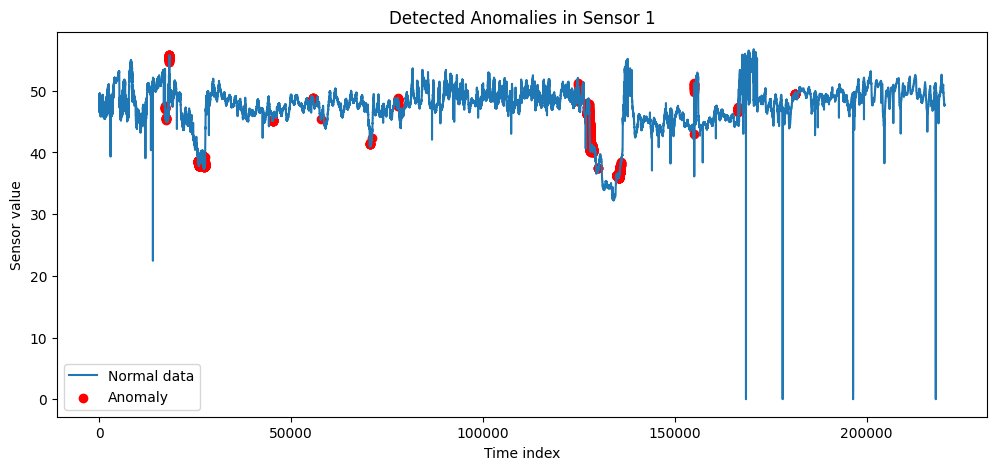
Process 220,320 observations from 52 industrial pump sensors, use PCA for visualisation and compare K-Means, DBSCAN and Isolation Forest for unsupervised anomaly detection.
- 03
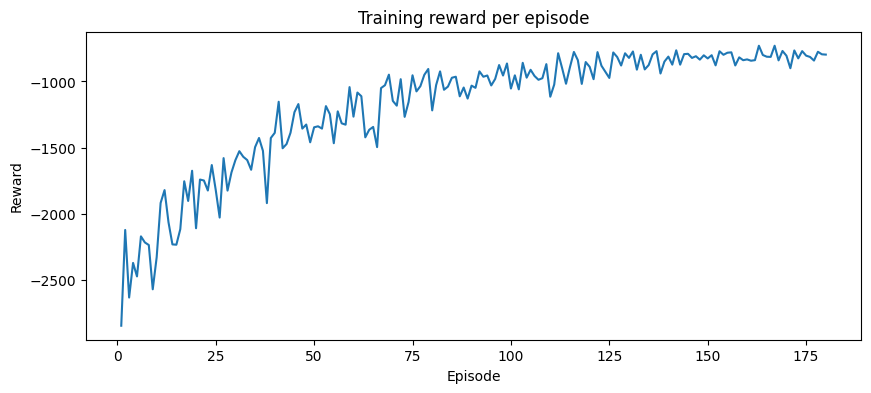
Review reinforcement-learning applications across the product lifecycle, then implement a PyTorch Deep Q-Network for heating and ventilation in a simplified building simulation.
- 04
Compare the learned controller with random, rule-based, energy-saving and air-quality baselines, and interpret both the improved reward and the remaining comfort-control limitations.
04 / Testing and outcome
What the work demonstrated
For concrete-strength prediction, the final voting ensemble achieved a test MAE of 3.63 MPa, RMSE of 5.15 MPa and R² of 0.897; Random Forest was the strongest single model. In the pump study, Isolation Forest identified 2,204 observations—approximately 1% of the dataset—as anomaly candidates for operator review, not confirmed failures. The DQN achieved the best mean episode reward in the simulated building study (-731 versus -1,075 for the rule-based baseline), but the near-zero share of fully acceptable comfort states shows that reward improvement did not equal satisfactory control. The monitoring and control studies are therefore presented as prototypes and evaluation exercises, not deployment-ready systems.
05 / Next iteration
How I would develop it further
- 1Use time-aware validation and labelled operating states to assess pump-anomaly precision and false alarms
- 2Redesign the RL reward and environment so comfort constraints are met, then repeat evaluation across independent seeds
- 3Validate the concrete-strength models on an independent mix-design dataset or experimental campaign
- 4Refactor repeated preprocessing and evaluation steps into reusable Python modules if the prototypes are developed further